Every tool a project uses is linked to from somewhere.
None of them hold the links themselves. Hyperlink Locker sits on top: the one layer that holds the connective tissue every project actually runs on. Designed, built, and shipped solo.
Every project runs on a stack of tools. Martech, sales tools, project management, storage, comms. And every one of those tools is linked to from somewhere: the Notion doc that links to the HubSpot deal, the Slack message that links to the Figma file, the email that links to the Drive folder.
Each tool holds its own content. But the links between tools, the connective tissue that makes a project run, live everywhere and nowhere. There's no layer that sits on top of the stack and holds just the links. By the time something matters, setup day, show day, anything with a deadline, someone is searching.
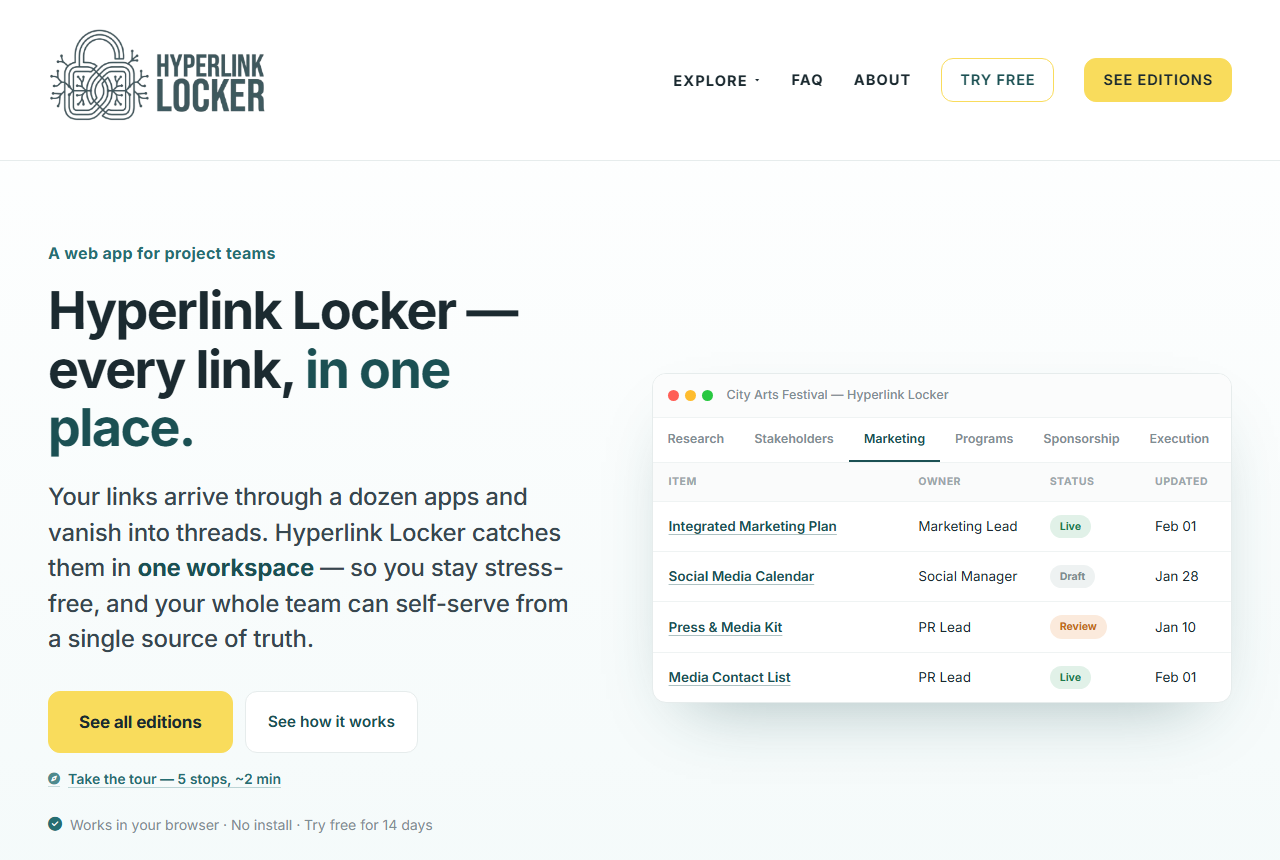
Purpose-built web app with persistent workspaces, multi-user access, and industry-specific editions, plus a Chrome capture extension. The data model, licensing, payments, and security were architected and shipped solo, with AI as the engineering layer. No install. No migration. No new platform for the team to learn.
Identify the missing layer, not a missing feature. Every project tool is already in the stack. The gap isn't another competitor. It's a layer above them all that holds the links between them. Hyperlink Locker was framed as infrastructure, not as an app competing with Notion or Asana. The category decision is what makes the product defensible: it doesn't replace anything, it connects everything.
Industry editions, not a generic tool. A general "link organizer" requires users to figure out how to structure it for their own work. That's the product doing less than it should. Hyperlink Locker ships pre-organized for one field: the tasks, the phases, the ownership model matching how that industry actually runs. You open it and it's already set up for your world.
Problem-first marketing. The site leads with the chaos: scattered apps, buried threads, the group chat nobody checks. By the time it names a solution, the visitor recognizes the problem. The copy is written to feel like an inventory of a day you've already had. One brand system runs across the product, the marketing, and this case study: the same palette and grid, so the work reads as one coherent system rather than a set of disconnected projects.
Solo today, full crew tomorrow. The product was designed for the full arc from one person to a full team: tiered licenses for individual use, per-seat team plans when the crew grows. Payments and licensing run through Gumroad, entirely offloaded, with a unique key delivered by email and redeemed in the app. No PCI surface to manage, no migration required, and nothing for the team to learn.