Organized by skill, proven by client work.
The first version of this site answered "who have you worked with?", which is a résumé question, not a hiring question. A hiring manager doesn't search by client name. They search by what they need done. So the site was rebuilt around the visitor's question instead.
The first version of this site organized work by client. It looked polished, showed projects cleanly, and did what most portfolios do. But it missed the only thing that matters: a hiring manager doesn't search by client name. They search by what they need done.
The site was built for the wrong reader. It answered "who have you worked with?" when the real question was "what can you do for me?" Rebuilding it wasn't a redesign, it was a repositioning. The structure had to change from client-first to skill-first, because the visitor arrives with a problem, not a company name in mind.
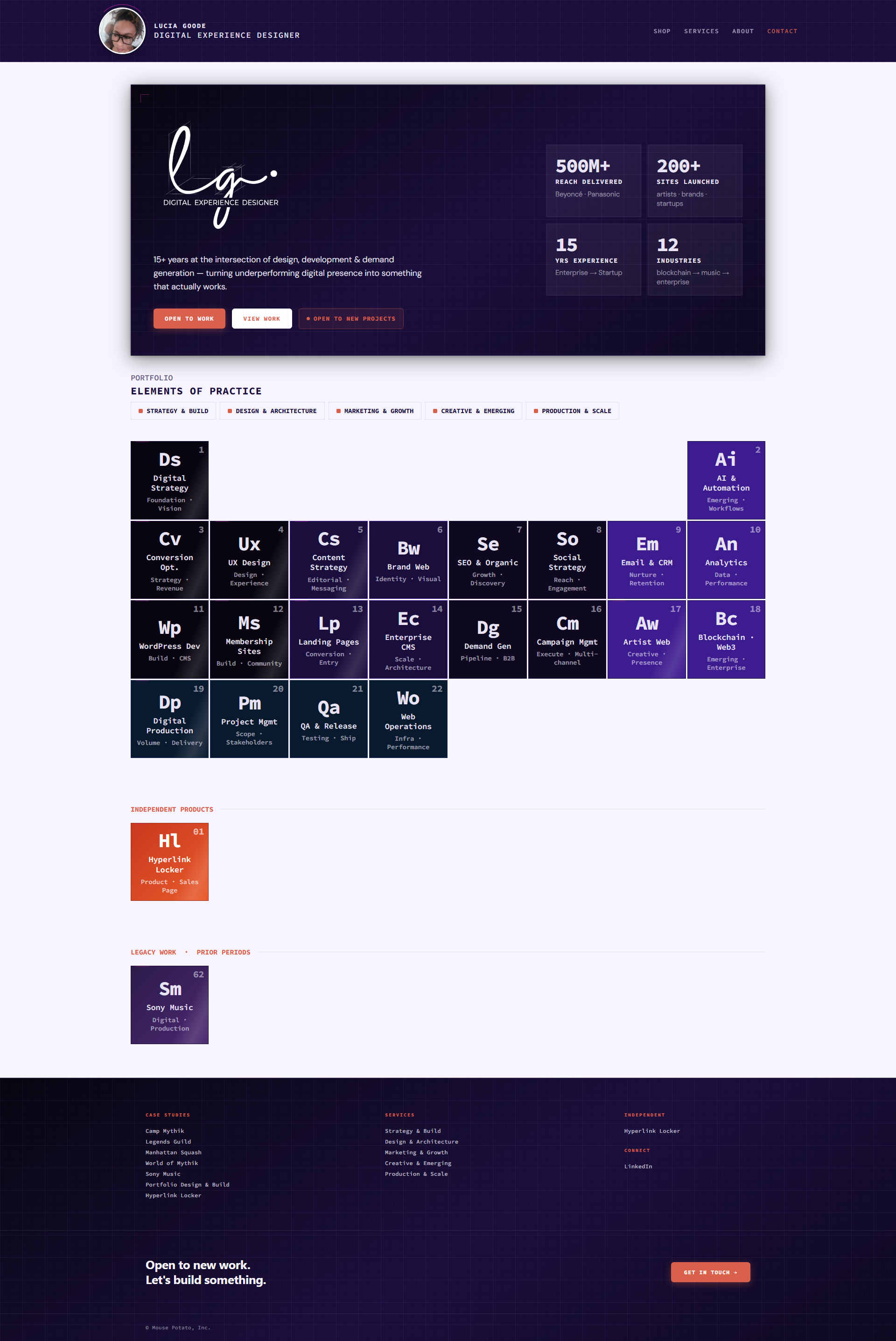
Built custom on an HTML and CSS stack, no framework, no CMS, with AI as the engineering layer. Every structural decision was made from first principles, which is the point: the site itself is a demonstration of the thinking it describes. The home page runs on a periodic-table architecture: every element is its own tile, and every tile is a skill. Case studies are written against the same element system, so the portfolio reads as one coherent argument rather than a set of disconnected projects.
Reframe the portfolio around the visitor's question, not the client's name. Version one organized work by company, which reads as a résumé. Version two organizes by skill, so a hiring manager can answer "can she do what I need?" in seconds. Same projects, same work, different question answered first. Repositioning, not redesign.
Structure the work as a periodic table, not a feed. Each discipline is a distinct tile, a skill that can be named, tagged, and applied. A visual system where every discipline has its own symbol and its own place, legible at a glance, legible without a click. The structure itself is the argument: range, organized.
Get to the point before the visitor has to ask. The hero states who this is for, what disciplines are covered, and what the visitor can do next, before the scroll. No fashion copy, no performative positioning. Respect for the visitor's time is the strategy. Every page on the site is built around the same principle: answer first, then expand.
One element system across every case study. Each project is written against the same toolkit: a dominant element, supporting elements, and moves tagged with the disciplines that drove them. Because the vocabulary is shared, the range becomes provable: a visitor can trace Cs across Camp Mythik, Legends Guild, and Manhattan Squash and see the same skill applied to different problems. The portfolio stops being a series of projects and starts being a body of work.